posted on December 16, 2010 by Merry-Jennifer
When I first started cooking, I followed recipes as though they were mandates. My scientific brain liked — and still does — precise measurements followed by detailed instructions. Preparing a recipe was very much like following a chemistry experiment. And you do NOT deviate from chemistry instructions. Not unless you like explosions, that is.
That method of cooking has it’s advantages, but the rigidness of that approach was often frustrating and stressful. If a recipe called for 2 cups of chicken broth and I only had 1 and 3/4 cup of chicken broth, well then I couldn’t make that dish, now could I? And I certainly couldn’t replace that extra 1/4 cup of liquid with, say, water or vegetable broth. Nope. If it wasn’t in the instructions, I didn’t do it.

Over time, I’ve forced myself to play with recipes and not follow them word for word, line by line. I started with baby steps – changing the amounts of measured spices, or swapping one spice or herb for another. It was a slow start, but making myself play with ingredients and becoming more creative with my cooking has completely paid off. It’s liberating, and even more importantly, it’s fun!
A book that has become an increasingly valued resource in my kitchen is The Flavor Bible by Karen Page and Andrew Dornenburg . For someone like me, someone who struggles with creativity in the kitchen, this book is a must have. The pages are filled with listings of ingredients, and below those ingredients are recommendations for other ingredients that complement or work well with that flavor profile.
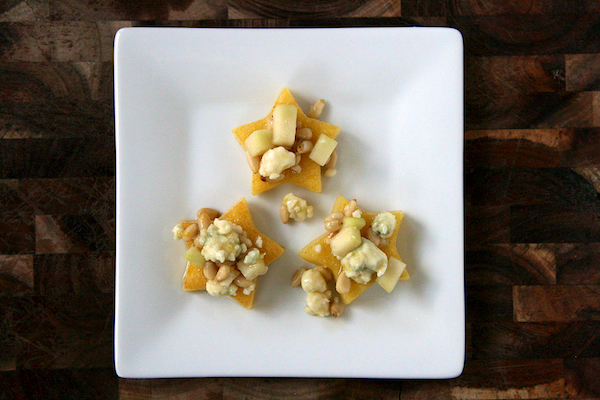
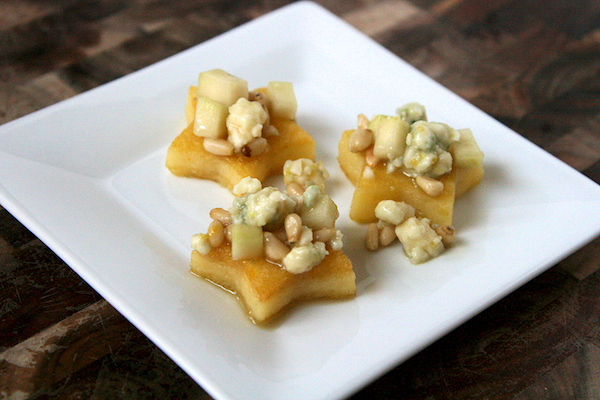
An example? Look up Gorgonzola cheese and you’ll find that honey and pears match quite well. Look up pine nuts, and you’ll see pears and honey listed as complementary flavors. Look up polenta, and you’ll notice that Gorgonzola cheese and honey are listed as ingredient pairings that work.
Put them all together and what do you have? A very nice little appetizer. Voilà!
Looking for a gift for a someone who loves to cook? Buy The Flavor Bible by Karen Page and Andrew Dornenburg. They’ll love it.
 Print
Print
Polenta with Pear, Gorgonzola, & Pine Nuts
Ingredients
- 4 cups water
- 1 cup quick-cooking polenta
- 1 teaspoon kosher salt
- 1 tablespoon butter
- Cooking spray
- 1 pear, peeled, cored, and diced
- 1/3 cup crumbled Gorgonzola cheese
- 3 tablespoons pine nuts, toasted
- 1 teaspoon lemon zest
- 2 tablespoons honey
- 1/4 cup extra virgin olive oil, plus more if needed
Preparation
- Bring 4 cups of water to a boil in medium saucepan. Gradually whisk in polenta and salt. Reduce heat to low and cook for 4 minutes or until thick, stirring often. Stir in butter. Pour polenta into a 9 inch square baking pan coated with cooking spray, spreading evenly. Press plastic wrap directly onto surface of polenta. Chill polenta for 1 hour or until polenta is very firm. Cut into 2-inch squares or use a small cookie cutter to make shape of your choice.
- Combine diced pear, Gorgonzola cheese, pine nuts, lemon zest, and honey in a small bowl and set aside.
- Add 1/2 inch olive oil to a large skillet and heat over medium-high heat. Working in batches, fry polenta pieces until golden brown, about 3 to 4 minutes per side. Using tongs, transfer fried polenta to a paper-towel lined plate to drain. Transfer polenta to a serving platter. Top each polenta square with a rounded spoonful of the pear and Gorgonzola mixture and serve.
posted on December 12, 2010 by Merry-Jennifer
I’m going to share with you a dirty little family secret. It’s the recipe that my family can’t resist, the one that’s only served at Thanksgiving and Christmas. If you are into eating only unprocessed and organic foods, you should look away now. Seriously, look away.
Are you ready? This is the secret:

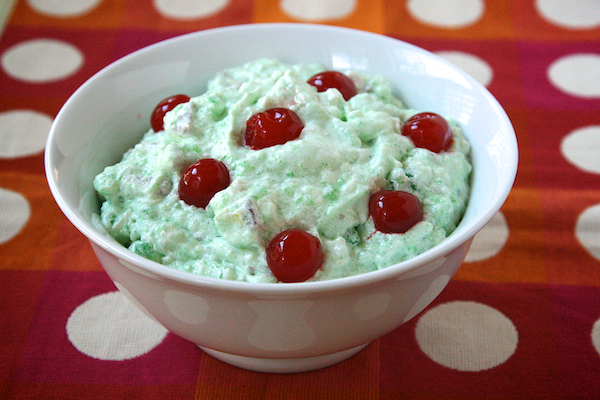
My mom’s Green Jello Salad. It’s not really a salad, as you can plainly see from the photo, but for some reason, these concoctions made with Jello are called Jello salad. When this dish is on the table during our holiday meal, there are rarely leftovers. The kids love it, and they usually fight over who gets the maraschino cherries. The adults love it, even though guests are commonly puzzled by what’s exactly in it.

The ingredients are very simple. Lime-flavored gelatin, cottage cheese, Cool Whip, pineapple, and nuts. And don’t forget the maraschino cherries for decoration, or you’ll have some angry children on your hands.
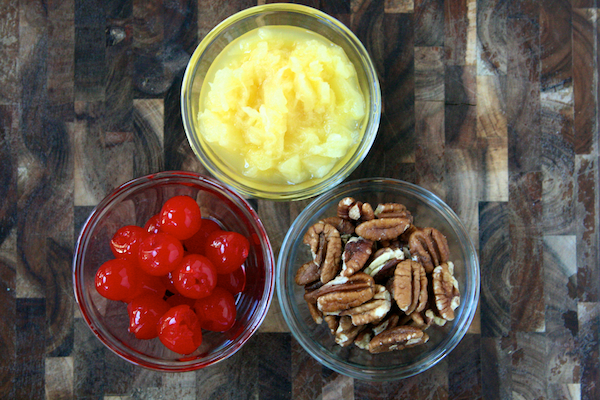
I wish I could say that this dish is so much better when I whip the whipped cream by hand using heavy cream or if I avoid the artificially-sweet crimson cherries on top, but it’s really not. This is a side dish – or dessert – that must be made with all of the processed ingredients, exactly as written. I have years and years of taste memories associated with Mom’s Green Jello Salad, and those aren’t found in any altered version of this recipe.
So, while the other dishes on the table at Christmas will be made from scratch using the best fruits and vegetables I can find in my organic market, there will be this one completely processed, as-opposite-of-organic-as-you-can-get dish on my menu.
And you know what? We’ll all go back for seconds.
Ingredients:
3 ounce package lime-flavored Jello gelatin
6 ounces cold pineapple juice
1 cup of Cool Whip
1/2 cup small curd cottage cheese
1/2 cup chopped pecans or walnuts
8 ounces crushed pineapple, drained
6 maraschino cherries (or more, depending on your love for maraschino cherries)
Directions:
Add 1 cup boiling water to gelatin in a bowl; stir 2 minutes or until completely dissolved. Stir in the cold pineapple juice. Refrigerate 2 hours, or until half-set.
Remove from refrigerator and add in the Cool Whip, cottage cheese, chopped nuts, and crushed pineapple. Mix until very well incorporated. Garnish with maraschino cherries and chill for at least one hour before serving.
posted on December 8, 2010 by Merry-Jennifer
I am not a bread baker. The process of baking bread intimidates me. I keep telling myself that I’m going to just try it, but I always chicken out. I’ve been eyeing some recipes lately – like this one for brioche by Brian and this one for focaccia by Jen – so maybe I’m close to giving it a go.
Maybe.
But until then, I’ll stick with baking biscuits. I can do that.

One of the best biscuit recipes that I’ve made is this one for rosemary cream drop biscuits. I’ve made them with and without the rosemary, and they are delightful both ways. The recipe I’ve included in this post is for another new favorite – buttermilk biscuits. Over the Thanksgiving holidays, I made these for my family. Wait. Who am I kidding? I made them for myself.
But I did let my daughter have one. So there.
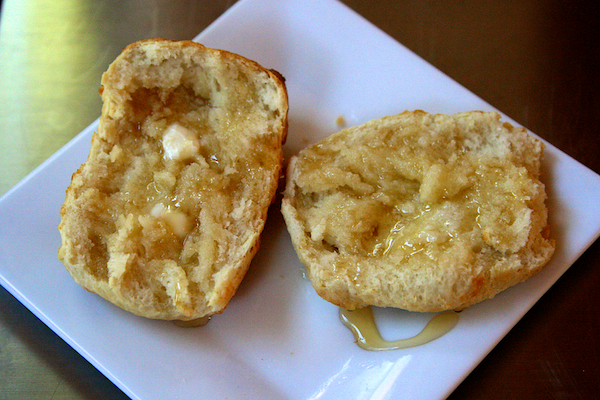
Warm buttermilk biscuits, slathered with some good butter and drizzled with honey…it was a tummy-warming and soul-satisfying snack. This, my friends, is my new go-to biscuit recipe.
By the way, if you have any favorite bread recipes, or if you want to give me some bread-baking encouragement, please leave me a comment. I need all the support when it comes to mustering up the courage to bake my first loaf of bread.
Ingredients:
1 1/2 cups all-purpose flour
1 teaspoon sugar
1 1/2 teaspoons baking powder
1/4 teaspoon kosher salt
1/4 teaspoon baking soda
1/2 stick (1/4 cup) cold unsalted butter, cut into 1/2-inch cubes
3/4 cup well-shaken buttermilk
Directions:
Put oven rack in middle position and preheat oven to 425 degrees F.
Whisk together until well-incorporated and aerated: the flour, sugar, baking powder, salt, and baking soda. Add butter and blend in with your fingertips until the mixture resembles coarse meal. Add buttermilk and stir with a fork until a dough just forms (dough will be moist and sticky).
Turn out dough onto a well-floured surface and knead gently 6 times. Pat dough on a floured surface with floured hands, reflouring surface if necessary, into an 8- by 5 1/2 inch rectangle. Trim all 4 sides with a knife, dusting knife edge with flour before each cut. Cut rectangle in half lengthwise, then into thirds crosswise to form 6 biscuits, flouring knife between cuts. Transfer biscuits with a metal spatula to an ungreased baking sheet, arranging them 2 inches apart. Bake until pale-golden, 12-15 minutes, then transfer to a rack to cool.

 Print
Print


